First time in Zug?
A walk from the station to the lake
Ten stops in about two and a half hours: from the station with James Turrell’s light through Zug’s old town, past the Zytturm, town hall, churches, castle and town wall, down to the lake, where the day ends with the sunset. The route is 2.4 kilometres long with only gentle slopes.
The walk at a glance
- Duration
- 2–3 hours2 h 40 min with the museum, 2 h 15 min without
- Distance
- 2.4 km on footabout 25 metres of climb, gentle slopes
- Start
- Zug stationEnds at the lake, 8 min back to the station
- Stops
- 10 stops3 highlights
- Best time to start
- 2 h 30 min before sunsetToday’s sunset
Tip: use «Print» in your browser’s menu to save this page as a PDF.
The highlights
If time is short, these are the stops not to miss.
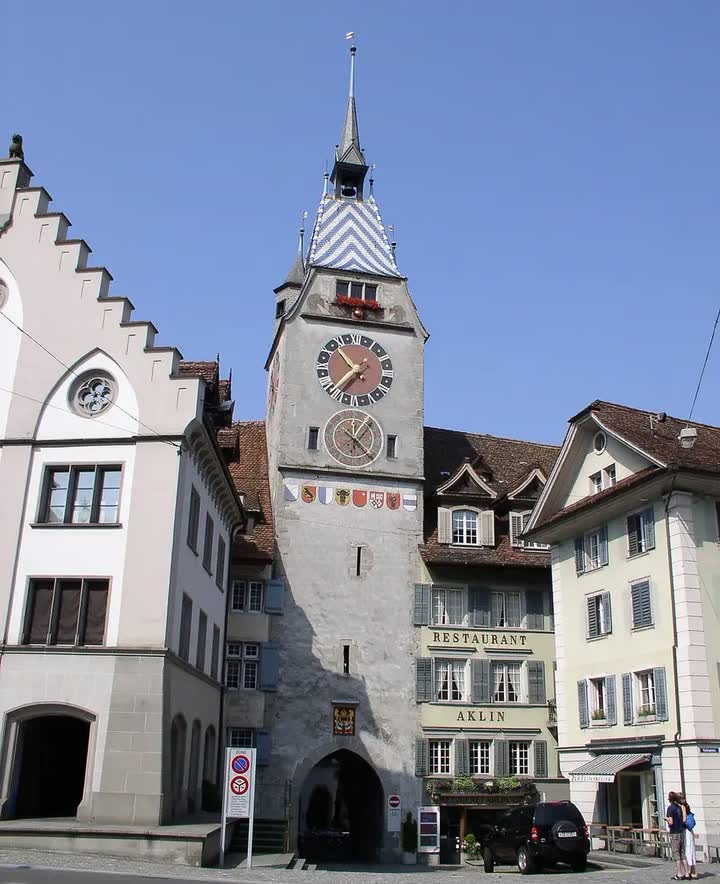
Photo: Baikonur, CC BY-SA 3.0 Stop 2
The Zytturm and its astronomical clock
Zug’s landmark is 41.5 metres tall, and its astronomical clock even shows the leap year. People who broke the town’s rules were once locked up in small cells in the tower, the «Timpis». After a lightning strike in 1863 the tower was given a new spire with a golden ball.
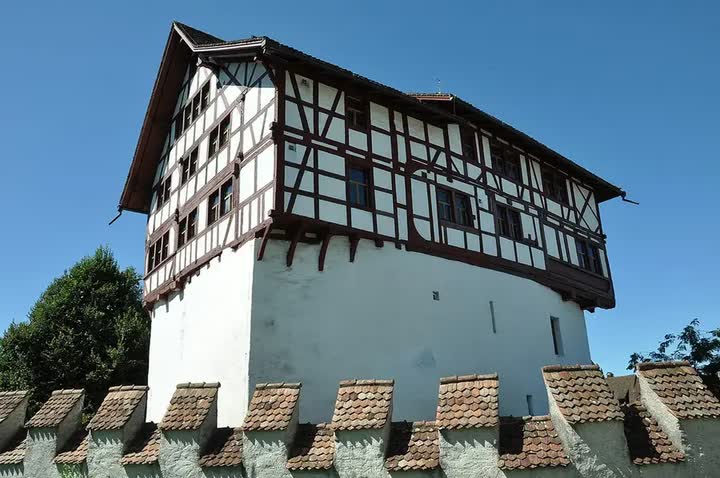
Photo: Schulerst, CC BY-SA 3.0 Stop 7
Museum Burg Zug
A medieval castle in the middle of the old town, now the museum of the history of the town and canton. There are suits of armour and halberds, but also everyday life over the last 500 years and a model of the town. The comic character Lili guides children through the rooms with questions.
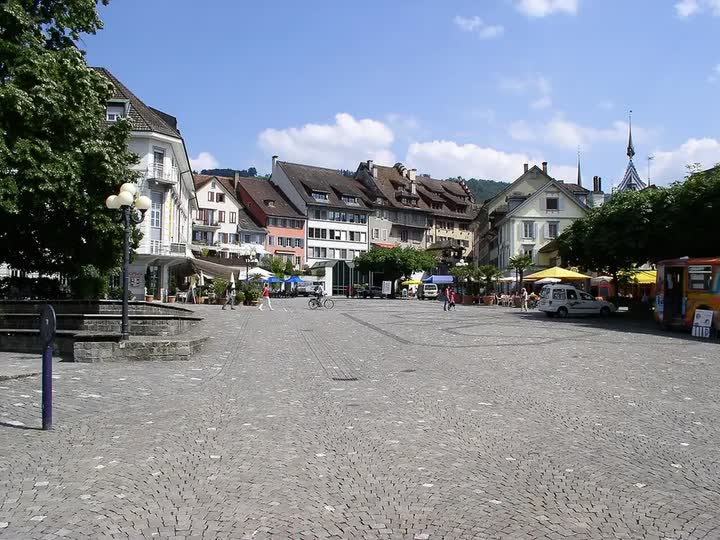
Photo: Baikonur, CC BY-SA 3.0 Stops 9 and 10
Sunset on Lake Zug
The walk is timed so that you reach the water for the sunset: from Landsgemeindeplatz and the Vorstadt promenade you look out across Lake Zug. On the way back, the station glows in James Turrell’s light.
The route at a glance
From the station down into the old town, along the lakeside lane, up to the church, castle and town wall, and finally down to the lake. Times are estimates from the start.
- Stop 1: Zug station and «light transport»Start
- Stop 2: Zytturm clock tower and Kolinplatzafter 19 min
- Stop 3: Town hall on Fischmarktafter 35 min
- Stop 4: Unter Altstadt: the lakeside laneafter 41 min
- Stop 5: Liebfrauenkapelle chapelafter 52 min
- Stop 6: St. Oswald’s Churchafter 1 h 4 min
- Stop 7: Zug Castleafter 1 h 20 min
- Stop 8: Town wall and Kapuzinerturmafter 1 h 59 min, 1 h 34 min without the museum
- Stop 9: Landsgemeindeplatzafter 2 h 7 min, 1 h 42 min without the museum
- Stop 10: Lakeside promenade in the Vorstadtafter 2 h 22 min, 1 h 57 min without the museum
Step by step
10 stops in the order of the walk, with time at each stop and the way to the next.
Stop 1: Zug station and «light transport»
Start · 5 min here
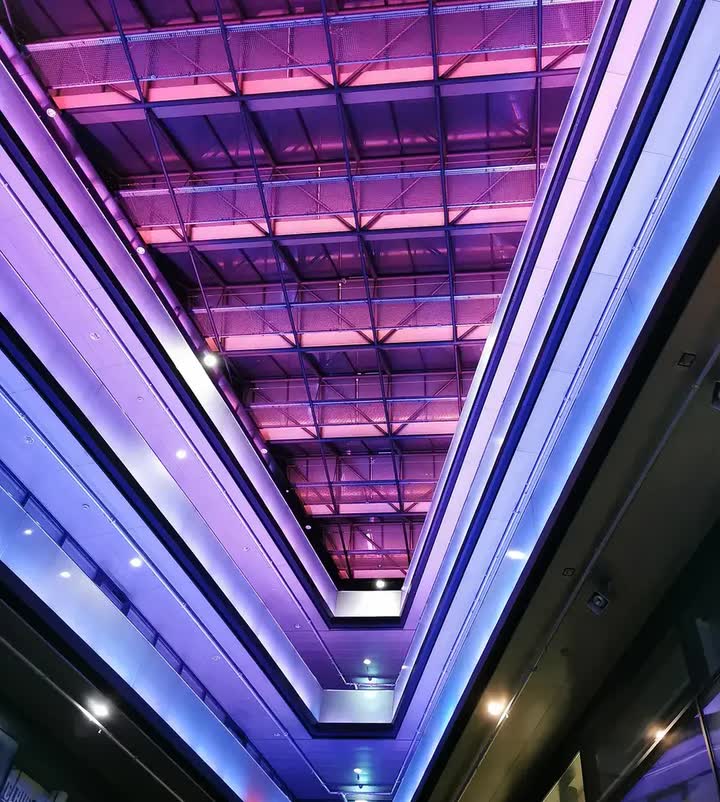
Photo: Elena Ternovaja, CC BY-SA 3.0 · Source · CC BY-SA 3.0 Your walk starts at the station, whose new building opened on 28 November 2003. Fluorescent tubes are mounted on its southern glass front: from dusk, James Turrell’s light installation «light transport» bathes the building in red, green, blue and mixed colours. In 2005 the station won one Brunel Award for the installation and another for its architecture.
Tip: By day you only see the tubes; you will see them glow on your way back after sunset. The Zug Tourismus tourist information is in the station hall, and you can leave luggage in a locker at the station.
On to stop 2: 14 min on foot, about 1.0 km. Along Bahnhofstrasse to Postplatz, then through Neugasse to Kolinplatz.
Stop 2: Zytturm clock tower and Kolinplatz
after 19 min · 15 min here Highlight
Photo: Baikonur, CC BY-SA 3.0 · Source · CC BY-SA 3.0 The 41.5-metre Zytturm is the landmark of Zug. It dates back to the 13th century, served as a gate and watchtower and took on its present form in 1557; the large clock followed in 1574, and below it an astronomical clock with four hands shows the day of the week, the month, the phase of the moon and the leap year. The east side bears the coats of arms of the Old Swiss Confederacy. On Kolinplatz stands the Kolin fountain of 1541: no one knows for certain whom the standard-bearer with the Zug shield and banner portrays, though today he is usually taken to be Wolfgang Kolin.
Right next to it: Kolinplatz mit Kolinbrunnen
Tip: You can climb the tower. Entry works with the eZug app or a badge; Zug Tourismus explains how and when the tower is open.
Accessibility: Parts of the old town are cobbled. If you are unsure whether the climb up the tower suits you, check with Zug Tourismus beforehand.
On to stop 3: 1 min on foot, about 30 m. A few steps to the town hall on the corner of Fischmarkt and Unter Altstadt.
Stop 3: Town hall on Fischmarkt
after 35 min · 5 min here
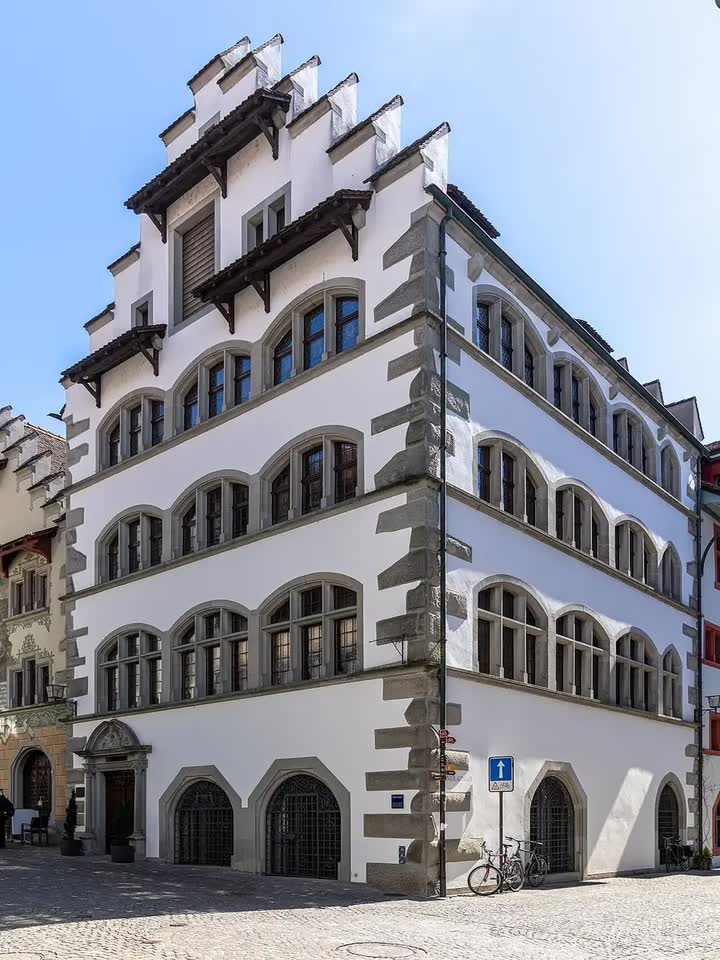
Photo: JoachimKohler-HB, CC BY-SA 4.0 · Source · CC BY-SA 4.0 The four-storey town hall stands on the corner of Fischmarkt and Unter Altstadt. Master builder Heinrich Sutter built it between 1505 and 1509. Today the Gothic hall on the top floor is used for exhibitions and cultural events.
On to stop 4: 1 min on foot, about 70 m. South along Unter Altstadt.
Stop 4: Unter Altstadt: the lakeside lane
after 41 min · 10 min here
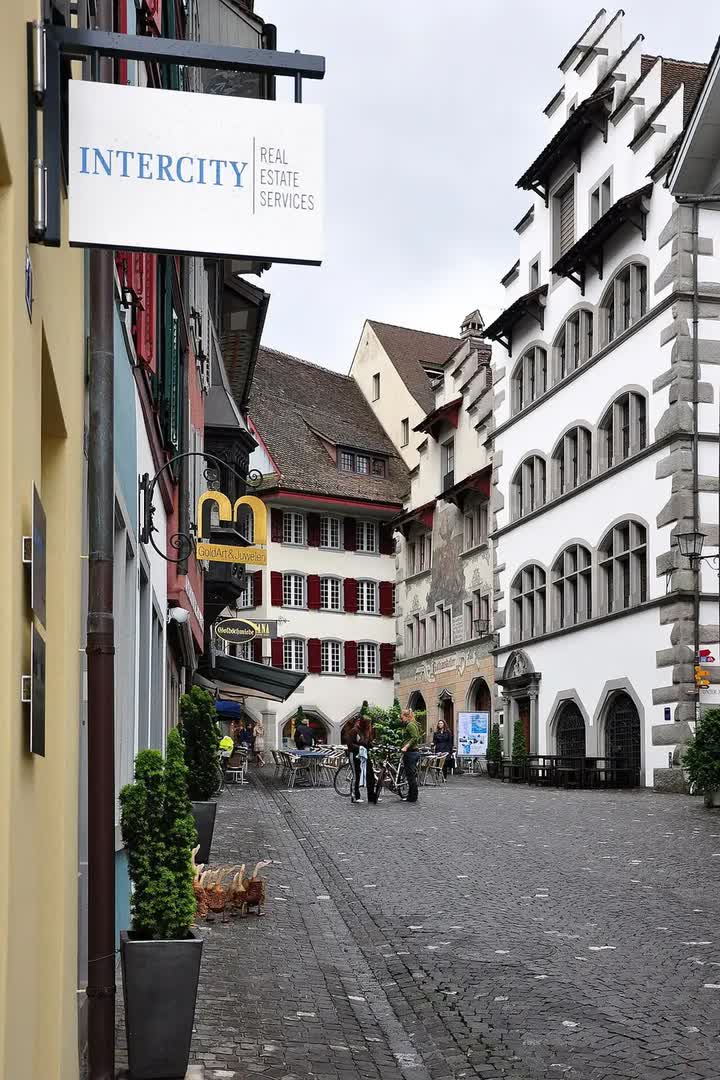
Photo: Roland zh, CC BY-SA 3.0 · Source · CC BY-SA 3.0 Zug’s old town looks back on some 800 years of history, and few Swiss towns have kept as many medieval buildings. How close it lies to the water became clear on 4 March 1435, when the lane then called Untergasse, below today’s lane, and the houses along the shore sank into the lake: 26 houses were destroyed and 60 people died. The small fishing museum by the lake shows how people fished on Lake Zug around 1900, and its demonstration hatchery raises, among others, the Zuger Rötel.
Tip: The Zuger Rötel is a char native to Lake Zug. First recorded in 1281, it was also used as a means of payment in the region until the late Middle Ages. The fishing museum’s opening hours are on its website.
Accessibility: Flat, cobbled.
On to stop 5: 1 min on foot, about 90 m. The Liebfrauenkapelle is at the end of the lane.
Stop 5: Liebfrauenkapelle chapel
after 52 min · 10 min here
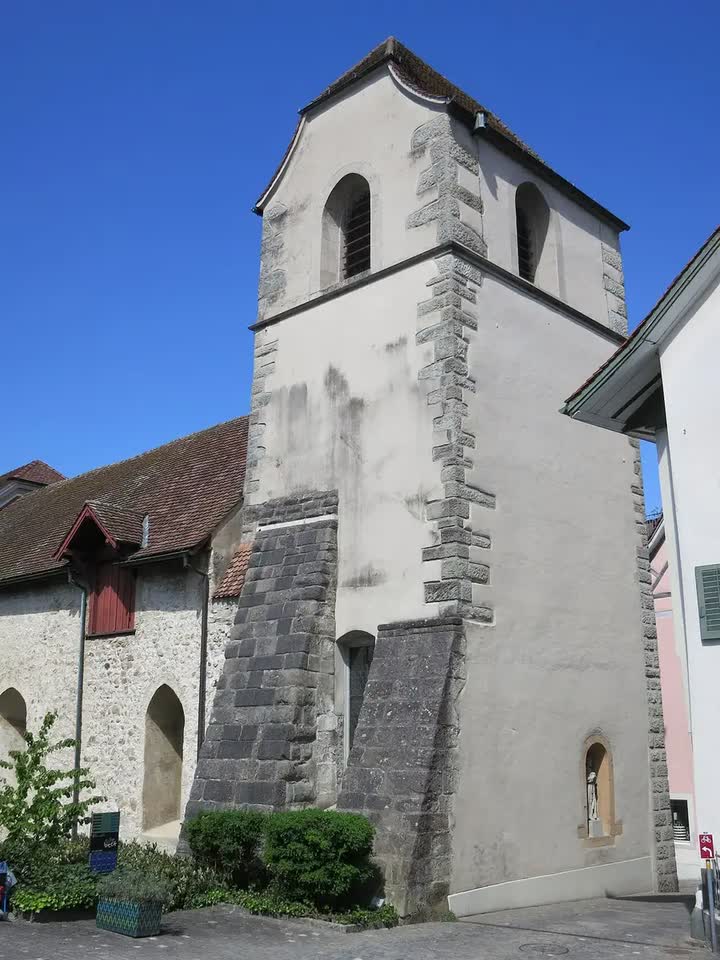
Photo: Paebi, CC BY-SA 3.0 · Source · CC BY-SA 3.0 The chapel was built in the 13th century together with the first town wall and is first mentioned in 1266; it is considered the oldest place of worship in Zug. From outside it was part of the fortifications; inside are late Gothic wall paintings and the Baroque cycle of the life of Mary, painted by the Zug artist Johannes Brandenberg in 1725–1727. Opposite the entrance stands the Greth Schell fountain, which shows Greth Schell carrying her drunken husband home.
Tip: Weddings are often held in the chapel, so be considerate if one is under way. On the Monday of Fasnacht (carnival), the guild of carpenters, turners and coopers keeps the Greth Schell custom alive and hands out sweets to children.
On to stop 6: 2 min on foot, about 170 m. Up St.-Oswalds-Gasse, gently uphill, to the church.
Stop 6: St. Oswald’s Church
after 1 h 4 min · 15 min here
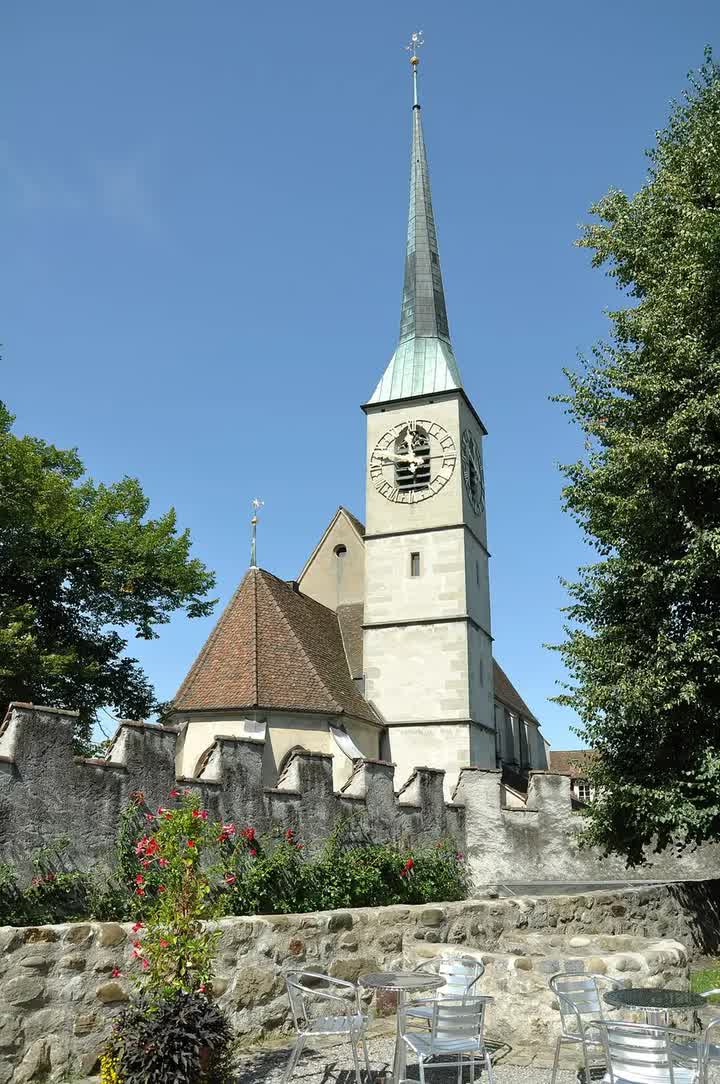
Photo: Schulerst, CC BY-SA 3.0 · Source · CC BY-SA 3.0 Work on St. Oswald’s began in 1478, made possible in part by booty from the Burgundian Wars. The master builder was Hans Felder, formerly master of works in Lucerne and Zurich; the church was later enlarged into a basilica with a nave and two aisles, and the spire followed in 1558. It counts among the largest and most representative late Gothic town churches in Switzerland. It is dedicated to St. Oswald, an early medieval king of Northumbria.
Tip: Look up above the doorways: five figures of saints stand beneath ornate, pinnacled canopies.
Accessibility: About 10 metres of gentle climb from the lakeside.
On to stop 7: 1 min on foot, about 70 m. Along Kirchenstrasse to the castle.
Stop 7: Zug Castle
after 1 h 20 min · 35 min with the museum, 10 min without Highlight
Photo: Schulerst, CC BY-SA 3.0 · Source · CC BY-SA 3.0 The castle’s beginnings go back to around the 11th century; in 1273 the Habsburgs secured all rights to it. The half-timbered building you see today was placed on the old shield wall by Johannes Zurlauben in 1555. Since its restoration from 1979 to 1982 the castle has looked as it did around 1770 and houses the cultural history museum of the town and canton of Zug. It tells of some 500 years of everyday life in Zug and includes a model of the town.
Tip: Allow a good half hour for the museum; opening hours are on the museum’s website. The Kunsthaus Zug is a few steps away.
Accessibility: There is a 10 cm step at the museum entrance; a mobile ramp is available. The lift serves floors 1–3; the 4th floor is reached by stairs only.
On to stop 8: 4 min on foot, about 310 m. East to the Knopfliturm on Knopfliweg, then north to the Kapuzinerturm on Schanz.
Stop 8: Town wall and Kapuzinerturm
after 1 h 59 min, 1 h 34 min without the museum · 5 min here
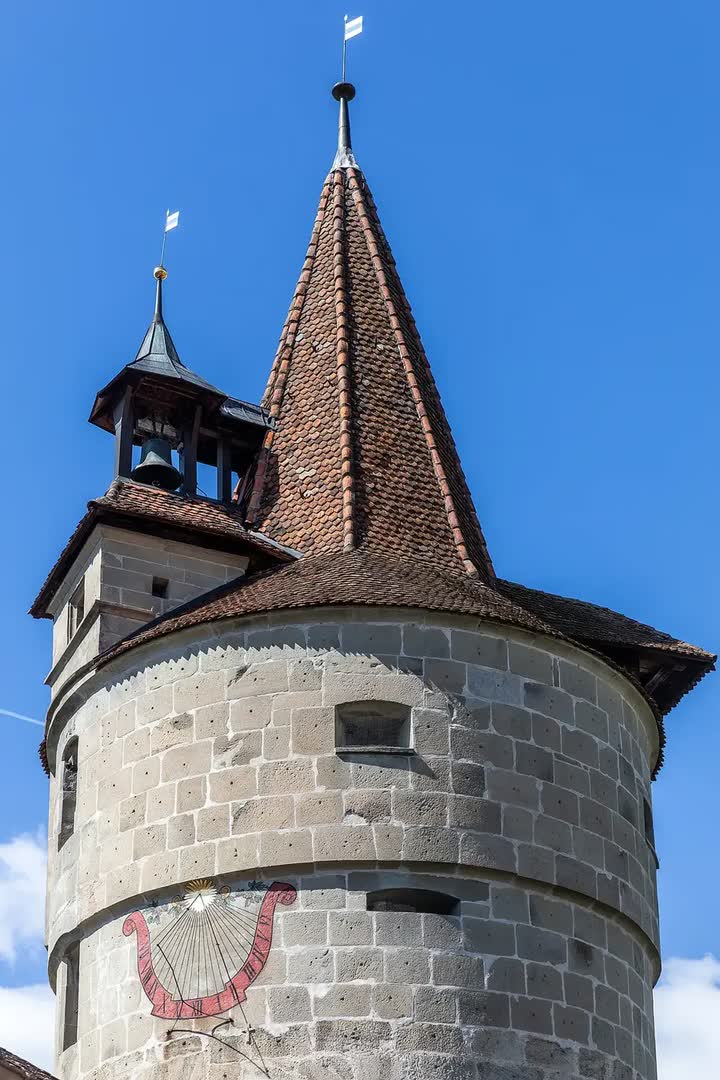
Photo: JoachimKohler-HB, CC BY-SA 4.0 · Source · CC BY-SA 4.0 The new town fortifications with their characteristic round towers were completed between 1518 and 1536. At the Knopfliturm this second town wall survives on both sides of the tower, together with a wooden wall walk restored in 1992. The Kapuzinerturm of 1526 marked the north-east corner of the ring of walls; it is named after the nearby Capuchin monastery, and since 1945 a small peace bell has rung here every 8 May to mark the end of the Second World War.
Right next to it: Knopfliturm und Stadtmauer
Tip: The tower has had many names, among them «Luegisland» and «Feuerglockenturm». Detour for the big picture: behind the main post office, the Guggi hill with its rose garden looks out over the old town, its towers and the lake.
Accessibility: Highest point of the walk, about 25 metres above the lake.
On to stop 9: 3 min on foot, about 230 m. Down towards the lake to Landsgemeindeplatz.
Stop 9: Landsgemeindeplatz
after 2 h 7 min, 1 h 42 min without the museum · 10 min here Highlight
Photo: Baikonur, CC BY-SA 3.0 · Source · CC BY-SA 3.0 The people of Zug once decided their politics on this lakeside square at the Landsgemeinde, the open-air assembly of citizens; Zug abolished it in 1848. Today Landsgemeindeplatz is the town’s meeting place, with restaurants and bars, weekly markets and festivals. From here you look across the lake into the sunset.
Tip: A good place for a break. Zugora’s «Now» page shows today’s sunset time.
Accessibility: From here the path is asphalt.
On to stop 10: 5 min on foot, about 410 m. North along the lake into the Vorstadt.
Stop 10: Lakeside promenade in the Vorstadt
after 2 h 22 min, 1 h 57 min without the museum · 20 min here Highlight
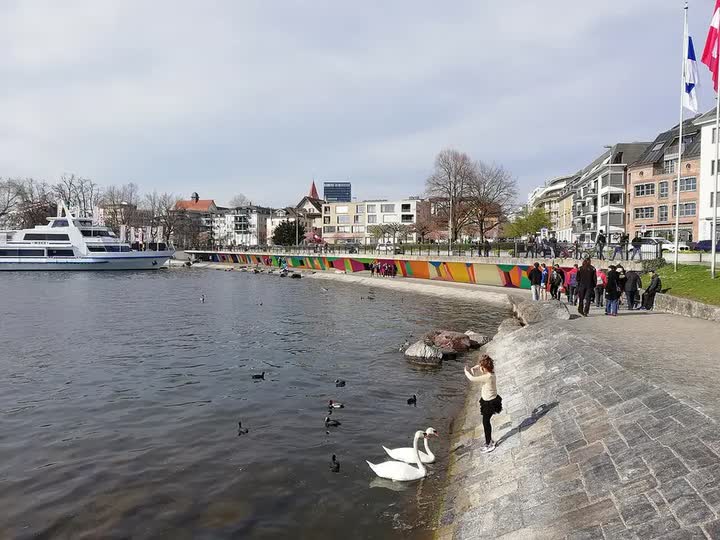
Photo: Ⲩ.Ⲅ., CC BY-SA 4.0 · Source · CC BY-SA 4.0 The Vorstadt was once a settlement on the shore outside the town walls. On 5 July 1887, during construction of a new quay, the shore gave way here: 35 buildings were destroyed, 11 people died and about 650 lost their homes. The bay it left behind is about 150 metres long and is now part of the Vorstadt promenade. Your walk ends here by the water, at sunset.
Tip: Right next door, the Lake Zug boats call at the Bahnhofsteg landing stage. The station is about 8 minutes away; after dusk Turrell’s light is on.
Accessibility: Asphalt and flat.
Back to the station: 8 min on foot, about 570 m.


If you have more time
Additions nearby, for a longer afternoon or a second day.
The Zugerberg by funicular
Take the bus from the station to the Schönegg valley station, then the funicular, running since 1907, up to the Zugerberg in about eight minutes. At the top you get views over the lake and the Alpine foothills and some 80 kilometres of marked trails. The funicular is wheelchair accessible; allow half a day.
A boat trip on Lake Zug
Scheduled boats leave from the Bahnhofsteg, about 400 metres from the station and right where the walk ends. Lake Zug covers just over 38 square kilometres and is up to 198 metres deep; there are evening cruises too. Timetable and season are on the Zugersee Schifffahrt website.
Kunsthaus Zug
A few steps from the castle, the Kunsthaus shows its collection of Viennese Modernism with works by Klimt, Schiele and Kokoschka, alongside Swiss Surrealism and art connected with Zug. The holdings are shown in changing exhibitions. Opening hours are on the museum’s website.
Zuger Kirschtorte
The confectioner Heinrich Höhn created the Zuger Kirschtorte in 1915: two Japonais layers of nut meringue, sponge soaked in kirsch syrup and buttercream flavoured with kirsch. Its name has been legally protected since 2015. The Zuger Kirschtorten Museum at Treichler, close to the route between the station and the old town, tells its story.
Guggi hill and rose garden
Behind the main post office, a few steps uphill take you onto the Guggi, an artificial hill. From the top you see the old town, its defensive towers, the castle and the Zytturm, with the lake and the Alps beyond; on the southern slope the Rosengesellschaft Zug tends a rose garden. A good place for an overview before or after the walk.
Good to know
- The walk starts at Zug station. The Zug Tourismus tourist information is in the station hall, and you can leave luggage in a locker at the station.
- Start about two and a half hours before sunset so that you reach the lake in time. Zugora’s «Now» page (weather and sun) shows today’s sunset time. Weather and sun
- The museums and the Zytturm have their own opening hours, which can change; check the websites of Museum Burg Zug, Kunsthaus Zug and Zug Tourismus. In summer the sun sets late, so visit the castle in the afternoon and come back to the lake in the evening.
- The route is 2.4 kilometres long, plus about 600 metres back to the station. Between the lake and the Kapuzinerturm it climbs about 25 metres.
- Parts of the old town are cobbled; from Landsgemeindeplatz onwards the path is asphalt. Comfortable, sturdy shoes help.
- With a wheelchair or pushchair: Zug Tourismus offers, on request, a step-free guided tour from the Zytturm to the station without stairs or thresholds, and the «Kolinplatz» bus stop is step-free. Accessibility details for individual places are on Ginto, linked from Zug Tourismus.
- In fog the old town lanes are especially atmospheric.
- Churches and chapels are places of prayer; please be considerate during services and weddings.
- You will also find every stop on the Zugora map. Open the map
Sources and rights
Facts
- Wikipedia (de.wikipedia.org): Bahnhof Zug, Zytturm (Zug), Kolinbrunnen, Zug ZG, Zugersee, St. Oswald (Zug), Burg Zug, Kunsthaus Zug, Landsgemeinde, Katastrophenbucht, Zugerbergbahn, Zuger Kirschtorte
- Zug Tourismus (zug-tourismus.ch): Tourist Information, Zytturm, Kolinbrunnen, Barrierefreie Stadtführung, Sehenswürdigkeiten Altstadt, Fischereimuseum, Liebfrauenkapelle, Greth-Schell-Brunnen, Kirche St. Oswald, Museum Burg Zug, Knopfliturm, Kapuzinerturm, Aussichtspunkt Guggi, Landsgemeindeplatz, Zugerbergbahn, Zugerberg, Zugersee Schifffahrt, Kunsthaus Zug, Zuger Kirschtorten Museum, Rosengarten, Barrierefrei, Zuger Altstadt
- SBB (sbb.ch): Bahnhof Zug
- Ginto (ginto.guide): Museum Burg Zug
- Zugersee Schifffahrt (zugersee-schifffahrt.ch): Anreise
Photos
- Stop 1, Zug station and «light transport»: Elena Ternovaja, CC BY-SA 3.0 · Wikimedia Commons · CC BY-SA 3.0
- Stop 2, Zytturm clock tower and Kolinplatz: Baikonur, CC BY-SA 3.0 · Wikimedia Commons · CC BY-SA 3.0
- Stop 3, Town hall on Fischmarkt: JoachimKohler-HB, CC BY-SA 4.0 · Wikimedia Commons · CC BY-SA 4.0
- Stop 4, Unter Altstadt: the lakeside lane: Roland zh, CC BY-SA 3.0 · Wikimedia Commons · CC BY-SA 3.0
- Stop 5, Liebfrauenkapelle chapel: Paebi, CC BY-SA 3.0 · Wikimedia Commons · CC BY-SA 3.0
- Stop 6, St. Oswald’s Church: Schulerst, CC BY-SA 3.0 · Wikimedia Commons · CC BY-SA 3.0
- Stop 7, Zug Castle: Schulerst, CC BY-SA 3.0 · Wikimedia Commons · CC BY-SA 3.0
- Stop 8, Town wall and Kapuzinerturm: JoachimKohler-HB, CC BY-SA 4.0 · Wikimedia Commons · CC BY-SA 4.0
- Stop 9, Landsgemeindeplatz: Baikonur, CC BY-SA 3.0 · Wikimedia Commons · CC BY-SA 3.0
- Stop 10, Lakeside promenade in the Vorstadt: Ⲩ.Ⲅ., CC BY-SA 4.0 · Wikimedia Commons · CC BY-SA 4.0
Zugora is an independent, unofficial platform. It is not a service of the Canton of Zug or its municipalities.
Current version, map and links: zugora.ch/en/first-visit/